Sentinel event and incident reporting for small clinics
A file separates in a canal, a needle breaks during a block, the wrong tooth is extracted. These things happen in careful clinics too. What separates a safe clinic from an unsafe one is whether the incident is written down, understood and turned into a change, so it doesn't happen again.
Healthcare regulators in Pakistan now ask for exactly that: a list of sentinel events, a record of each incident, its root cause and the corrective action. FindClinica's Sentinel Events register keeps it in one place, on your phone and the reception computer.
Updated
Sentinel event, adverse event, near miss
The Joint Commission defines a sentinel event as a patient safety event, not caused by the natural course of the patient's illness, that reaches the patient and results in death, permanent harm or severe temporary harm. WHO's patient safety classification adds the smaller ones: an adverse event reached the patient and caused harm, a no-harm incident reached the patient without harm, and a near miss was caught before it reached the patient.
Near misses are the cheapest lesson a clinic gets, which is why the standards ask for them to be reported too, without blame.
How often it happens in dentistry
More often than most of us assume. In a US study that reviewed 958 dental records with a trigger tool, 101 adverse events were confirmed, most often pain and infection after treatment. Wrong-tooth extraction made up a fifth to a quarter of the wrong-site never events reported in NHS England, and in one survey about one in five dentists said they had extracted a wrong tooth at some point. In endodontics, separated instruments were found in 3.3% of more than 8,000 cases in one large study, and rates vary widely between studies.
What the regulators ask for
Islamabad (IHRA). The dental MSDS has a standard that sentinel events are assessed and managed, and an indicator that the clinic has listed the sentinel events to watch for; inspectors look for that documented list, incident logs and corrective action records. The GP MSDS asks for an incident reporting system covering medical errors, adverse drug events, needle-stick injuries and falls, for incidents to be analysed for root causes with the corrective and preventive actions recorded, and for near misses to be reported without blame.
Sindh (SHCC). The standards for clinics include the same requirement that the clinic has listed its sentinel events, and ask for incidents and near misses to be reported and analysed to find their causes.
Punjab (PHC). The Minimum Service Delivery Standards are released through a request form, so we haven't quoted them here. Keeping the same kind of register is the safe assumption.
Root cause analysis, kept simple
A root cause analysis doesn't need a committee. The Joint Commission's framework comes down to a few steps that work in a two-chair clinic: write down what happened, in order; compare it with what should have happened; look at the contributing factors (people, equipment, environment, staffing, communication); keep asking why until you reach something you can change; choose the strongest fix you can; and check later that it worked. The NHS calls the asking part the five whys.
The fix matters more than the paperwork. "Be more careful" is the weakest kind of fix; a rule that rotary files are single-use in molars, or a checklist read aloud before an extraction, is a strong one.
The register in FindClinica
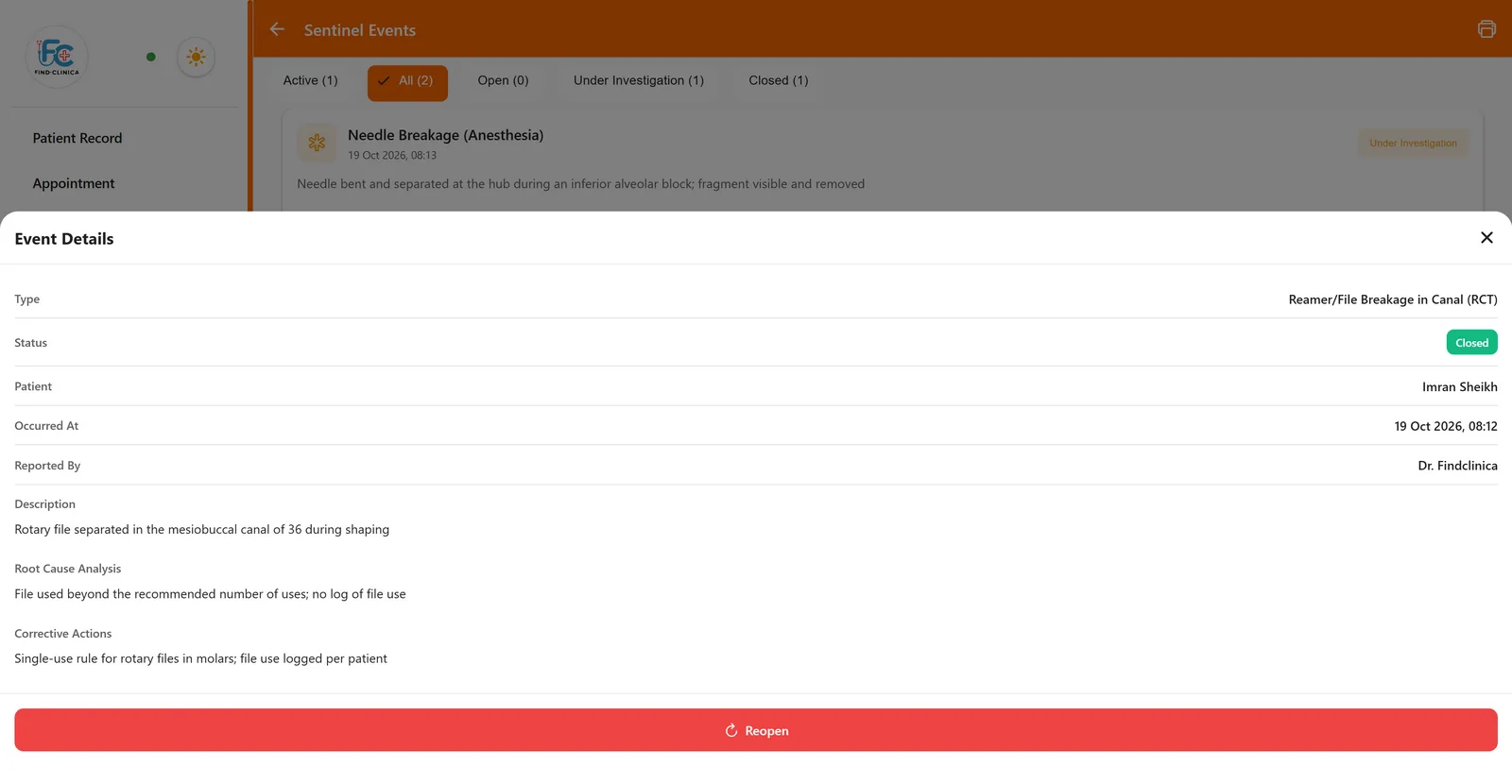
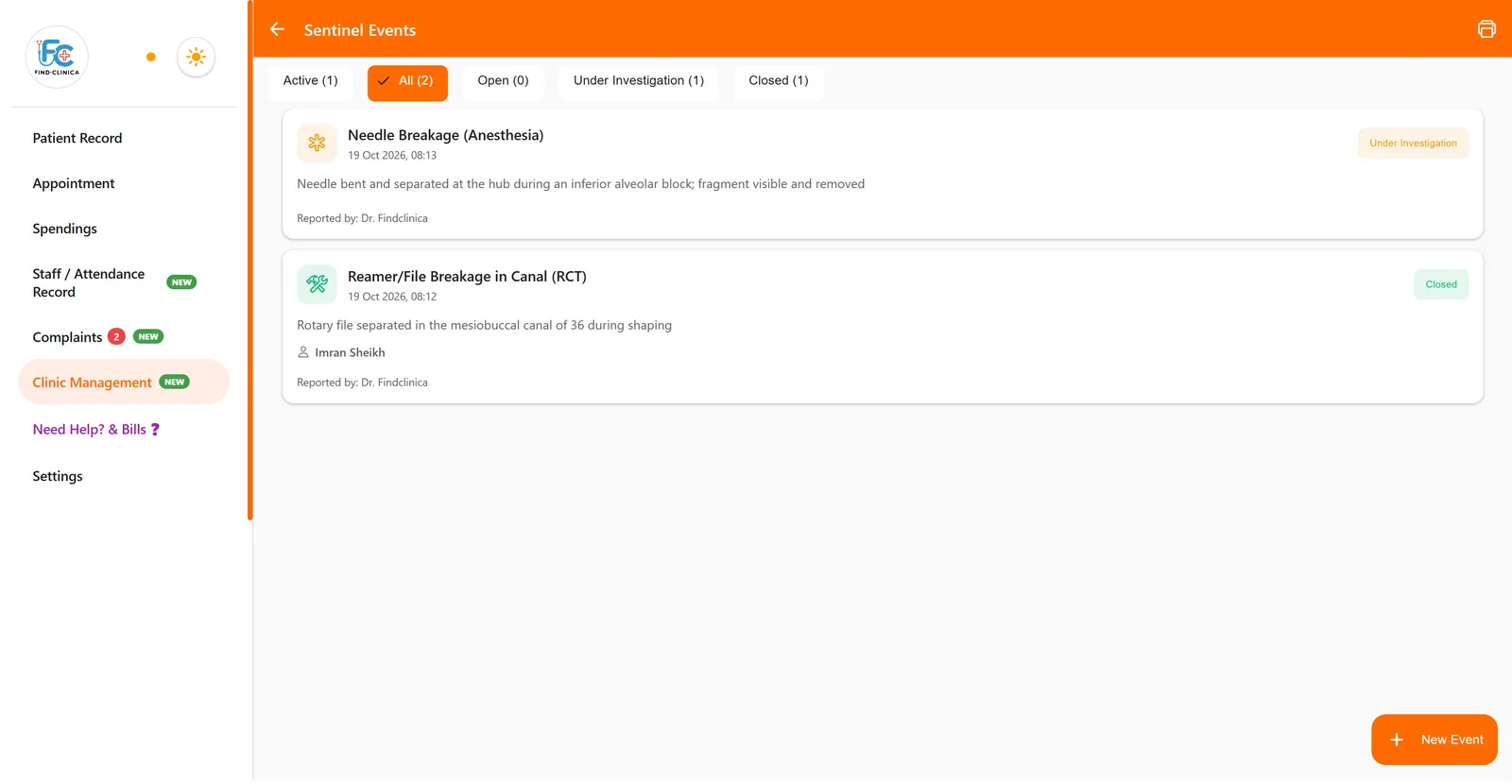
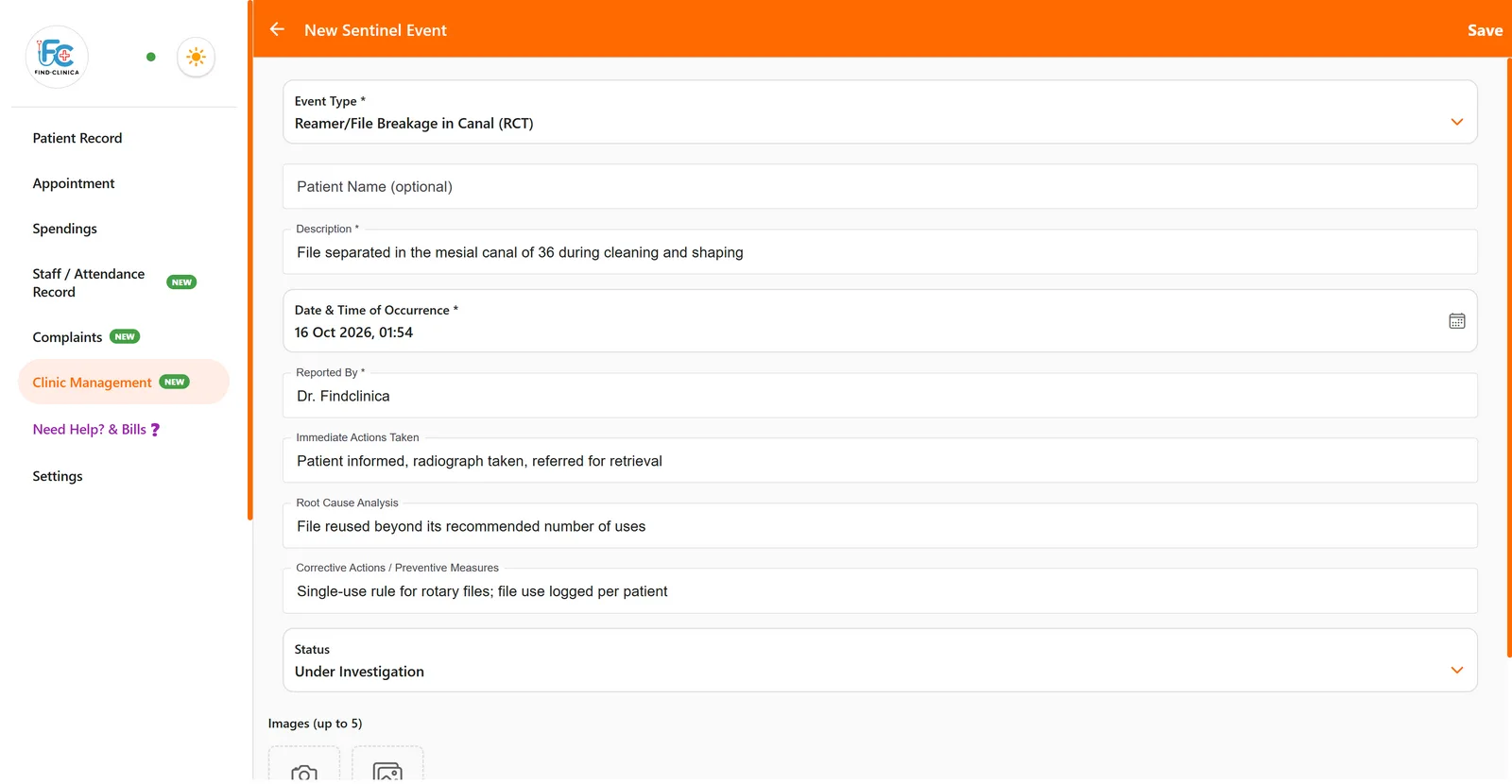
Open Clinic Management, then Sentinel Events, and press New Event. Pick the event type from the built-in list, which covers the dental events inspectors expect to see: wrong tooth extraction or treatment, jaw fracture during extraction, needle breakage, reamer or file breakage in a canal, a swallowed crown, file or implant part, nerve injury or paraesthesia, a severe drug allergic reaction, tuberosity fracture, and violence against staff or against a patient. Anything else goes under Other.
Then write the description, the patient's name if there was one, when it happened and who reported it, the immediate actions, the root cause analysis and the corrective or preventive measures. You can add up to five photos, such as the radiograph.
Each event moves from Open to Under Investigation to Closed, and a closed event can be reopened. The list filters by status, and the print button makes a report for all events, or the last 30 days, 90 days or 12 months, with your clinic's name, the totals for each status and a table of every event.
What it doesn't do
The patient's name on an event is free text; it isn't linked to their file, so note the incident in the visit record as well. The register doesn't notify anyone, and photos don't appear in the printed report. The built-in types are dental; a GP clinic can record its incidents under Other, with a clear description.
Common questions
Should near misses go in the register?
Yes. IHRA's GP standards ask for near misses to be reported without blame, and they are the easiest incidents to learn from.
Who can record an event?
Anyone using the clinic's account, on the owner's phone or a connected computer. The form records who reported it.
Can I print the register for an inspection?
Yes, for all events or the last 30 days, 90 days or 12 months.
Does recording an event need internet?
No. The event is saved on the device and syncs later. Only adding photos needs a connection.
Read next
- Clinic software in Islamabad (IHRA)
- Clinic software in Karachi (SHCC)
- Healthcare waste log for clinics
- Patient complaint QR code
More for clinics in Pakistan
- Dental Clinic Software in Pakistan
- Clinic Management Software in Pakistan
- EMR Software in Pakistan for Small Clinics
- Prescription Software for Doctors in Pakistan
- Patient Record App for Doctors
- Paper Register vs Excel vs Clinic Software
- Best Clinic Software in Pakistan, Compared
- Clinic Management App for Android
- Clinic Software in Lahore
- Clinic Software in Karachi
- Clinic Software in Islamabad
- Software for Clinics With More Than One Doctor
- Online Prescription Maker for Doctors
- Software for Orthodontists in Pakistan
- Clinic Software That Works Offline
- How to Read a Periodontal Chart
- Patient Complaint QR Code for Clinics
- Healthcare Waste Log for Clinics in Pakistan
- Patient Aftercare Instructions on WhatsApp
- Free Clinic Software for Windows
Free tools and templates
Sources
- The Joint Commission: sentinel event policy (2026)
- The Joint Commission: framework for root cause analysis and corrective actions
- Runciman et al., the WHO International Classification for Patient Safety (2009)
- NHS England: the five whys
- Kalenderian et al., classification of dental adverse events (2017)
- Wrong-site never events in NHS dentistry
- Survey of wrong tooth extraction among dentists
- Separated instruments in 8,460 endodontic cases
- IHRA Dental Minimum Service Delivery Standards
- IHRA GP Minimum Service Delivery Standards
- SHCC standards for clinics and primary healthcare facilities
Try it with your next patient
The free plan costs nothing and has no time limit. Install it and add one patient, or ask us anything on WhatsApp first.